FMCG brands raise festive ad spends 10-15% despite margin & demand pressures
The increase comes against pressure on both margins and consumption, making advertisers more selective about where they deploy budgets and how quickly campaigns translate into sales
 by
Published: Nov 4, 2026 8:49 AM | 8 min read
 Follow Us


- FMCG brands are increasing their festive advertising budgets by 10-15% compared to last year, despite pressures on margins and consumption, with some companies like Nestlé India and Marico reporting year-on-year increases of 46% and 44%, respectively.
- Advertisers are adopting a more selective approach to spending, focusing on digital commerce and measurable returns, while balancing the need for market share with margin protection.
- Urban FMCG expenditure has declined by 4%, contrasting with a 15% growth in rural areas, highlighting an uneven recovery in consumer spending amid economic concerns.
- Increased scrutiny from the Food Safety and Standards Authority of India (FSSAI) is prompting brands to ensure transparency and credibility in their advertising and product claims, as consumers demand authenticity and value for money.
FMCG brands are sustaining their festive advertising push, with the average ad spend in the ongoing season expected to be 10-15% higher than last festive season, according to industry executives.
This increase comes amid pressure on both margins and consumption, making advertisers more selective about where they deploy budgets and how quickly campaigns translate into sales, industry leaders told e4m.
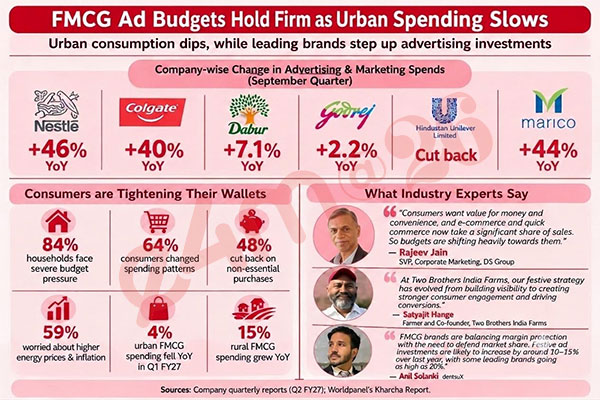
Several leading companies have already stepped up investments in the September quarter. Nestlé India increased its advertising and marketing spends by 46% year-on-year, while Marico reported a 44% increase. Colgate-Palmolive raised AdEx by 40%, while Dabur and Godrej Consumer Products reported increases of 7.1% and 2.2%, respectively. Hindustan Unilever, meanwhile, reduced its ad spends.
“The festive season remains an important opportunity to defend market share, build brand visibility and drive consumption. We are spending more this time, but the approach is more calibrated, with greater emphasis on audience relevance, digital commerce and measurable returns,” senior marketers from listed FMCG majors told e4m.
According to executives, the average ad spend of FMCG brands this ongoing season is 10-15% higher than last festive season. The increase comes against pressure on both margins and consumption, making advertisers more selective about where they deploy budgets and how quickly campaigns translate into sales.
Rajeev Jain, Senior Vice President, Corporate Marketing, DS Group, said festive spends had risen modestly for the company, particularly in spices, while expectations around returns had become sharper.
“Consumers want value for money and convenience, and e-commerce and quick commerce now take a significant share of sales. So, budgets are shifting heavily towards them, though it varies by category. Cooking spices convert well on quick commerce, while Pulse candy still sells mostly in physical retail. AI helps us with speed and scale in festival campaigns and local language adaptations,” Jain said.
The shift towards digital commerce has not made traditional media redundant. Channel choices continue to depend on category requirements and the audience a brand needs to reach. “It’s not TV versus digital, it's TV and digital together. If my brand requires mass reach, I still need linear TV. But CTV, digital video, influencers and paid social are seeing strong investment. Linear TV, print and display will continue, but the share is shifting to digital,” Jain said.
For D2C food brands, the challenge is to build consumer engagement without competing with larger advertisers on reach and frequency. Satyajit Hange, farmer and co-founder of Two Brothers India Farms, said the company's festive strategy had evolved from building visibility to driving engagement and conversions.
“At Two Brothers India Farms, our festive strategy has evolved from building visibility to creating stronger consumer engagement and driving conversions. This year, we have focused on reaching wider audiences through digital campaigns, storytelling and commerce-led initiatives, while ensuring our communication stays rooted in food quality, provenance and tradition,” Hange said.
The company's communication focuses on ingredients, sourcing and the people behind its food, while prioritising measurable outcomes without compromising long-term brand building.
According to Anil Solanki, Media Lead, dentsuX, festive ad investments are likely to increase by 10-15% over last year, with some leading brands going as high as 20%. “Brands are balancing margin protection with the need to defend market share,” he said.
Solanki said brands were moving away from blanket visibility towards sharper media allocation, regional targeting and conversion-led campaigns. Value packs, promotional offers and premiumisation are also being used to address different consumer segments. Following FSSAI scrutiny, he said, brands need to place greater emphasis on transparency and credible product claims.
Also Read: Sugar Squeeze & Regulatory Heat: FMCG marketers brace for double whammy
Market turbulence puts festive ad spends to the test
Profitable growth and sharper targeting
The pressure to demonstrate returns is changing how brands approach the festive calendar. While the October-December quarter remains a major consumption opportunity, industry executives caution against treating it as a substitute for sustained brand investment through the year.
“Festive is one of the key periods for the FMCG category. Some brands move upwards of 50% of their entire inventory in the 3 festive months. However, my observation has been that the marketing push during festive yields results only if there has been significant spend during the non-festive period,” said Mohit Ghate, CEO of Wit & Chai.
His observation points to the importance of building brand preference before the festive advertising clutter intensifies. Shradha Agarwal, Co-founder and CEO, Grapes, said brands were increasingly moving from maximising reach to maximising profitable growth, becoming more selective about the categories, markets and consumer groups where advertising could influence purchase decisions.
She added that premiumisation continued to create opportunities in some categories, while value-conscious consumers were looking for affordability, convenience and stronger product propositions. Festive communication, therefore, needs to address both aspiration and value.
Nisha Singhania, Co-Founder and Managing Partner, Infectious Advertising, said the focus was on improving the productivity of marketing budgets. “The focus is on getting more out of every rupee, with sharper targeting and greater emphasis on digital, e-commerce and quick commerce. It is less about spending more, instead more about ensuring that investments translate into actual consumption and growth,” she said.
Ghate believes that brands also need to anticipate changes in consumer preferences rather than respond only when a trend becomes widespread. “When everyone is advertising, consumers tend to buy from brands they already trust. Some brands have not recognised this and end up spending significant amounts during the OND quarter,” he said.
He added that while health and wellness were prominent themes in the previous festive cycle, some brands were now placing greater emphasis on taste and celebration, reflecting changing consumer preferences.
Aalap Desai, CCO & Co-founder at tgthr, shared that festive spending remains resilient in Tier 2 and 3 markets. "Diwali continues to be a priority for consumers in smaller towns, where families save through the year for celebrations. Hence, brands are willing to absorb higher prices rather than compromise on festive spends," said Desai.
Urban spending falls 4%, rural grows 15%
The cautious approach to advertising comes against a challenging consumption backdrop. According to Worldpanel, formerly Kantar, expenditure on fast-moving consumer goods slowed in the first quarter of FY27, primarily in urban areas, amid concerns over fuel and food prices and cutbacks on non-essential purchases.
The fourth annual Kharcha report found that urban quarterly FMCG expenditure declined 4% year-on-year, compared with 14% growth in the corresponding period a year earlier. The contraction was visible across both affluent and less affluent urban households.
Affluent households, which spent an average of ₹81,759 per quarter, and less affluent households, with average expenditure of ₹49,832, each recorded a 4% decline. Rural expenditure, in contrast, grew 15% to ₹53,760.
The divergence points to an uneven consumption recovery. While rural spending continues to expand, urban households across income groups are showing greater restraint, making a uniform national advertising or promotional strategy less effective.
Sharing findings from the report on LinkedIn, Mangalam Maloo, Deputy Editor at a leading business news platform, who tracks the FMCG sector, observed: “Data around India's consumption environment is telling! It's not painting a pretty picture for the masses.”
The household sentiment indicators cited in his post reinforce the pressure on consumer budgets: 84% of Indian households reported severe budget pressure, 64% of consumers had changed their spending patterns and 48% had cut back on non-essential purchases. Nearly six in ten were concerned about higher energy prices and inflation.
Trust and compliance shape brand communication
Alongside price and value, credibility is becoming an important part of brand differentiation. Consumers are evaluating product quality and claims more closely, while food and beverage companies face greater scrutiny across packaging, advertising, influencer content and online commerce platforms.
The Food Safety and Standards Authority of India has issued more than 150 notices to food and beverage manufacturers, e-commerce platforms and food-service businesses over alleged misleading claims and other violations. Companies named in reported notices include Nestlé, ITC, PepsiCo, Mondelez, Red Bull, Zepto and Swiggy.
The scrutiny adds to the pressure on companies already dealing with input-cost inflation and margin concerns. As reported earlier by e4m, rising prices of key ingredients had forced packaged-food companies to reassess costs and marketing priorities. Brands now need to protect profitability without weakening consumer confidence.
“Following FSSAI actions, brands need to ensure that their claims are accurate, substantiated and consistent across packaging, advertising, influencers and commerce platforms. Trust cannot be built through a festive campaign if the underlying product experience does not support the promise,” Agarwal said.
She said brands should measure not just awareness and engagement but also consideration, branded search, repeat purchases, conversion, consumer sentiment and incremental sales.
The challenge is particularly pronounced among younger consumers, whose attention is increasingly difficult to secure. Jain said Gen Z consumers were less inclined to accept brand claims at face value. “They look for authenticity, transparency and lived product experience. Earlier, brands competed for attention. Today we compete for algorithmic recommendation, and after that, product quality and reliability drive repeat purchase and advocacy,” he said.
He added that micro and nano influencers were connecting effectively with audiences in smaller towns, delivering strong returns. “Impressions are only outputs. Our focus is on business outcomes and ROAS,” he said.
e4m reached out to marketers at leading FMCG companies, but they declined to comment, citing their current silent period.
Read more news about Marketing News, Advertising News, PR and Corporate Communication News, Digital News, People Movement News
For more updates, be socially connected with us onInstagram, LinkedIn, Twitter, Facebook, YouTube & Google News